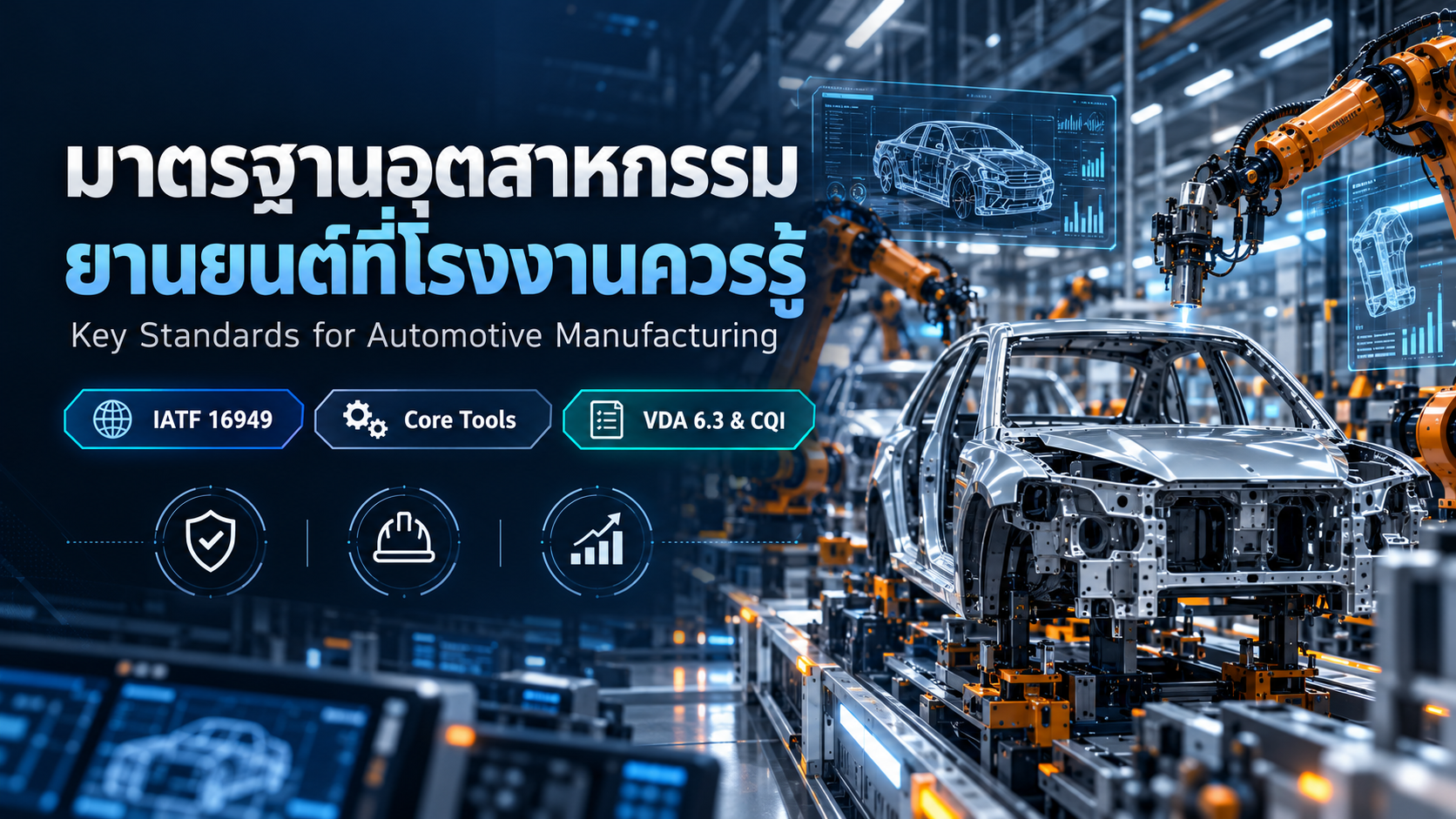
Automotive Industry Standards Every Manufacturer Should Know
Quality Management, Manufacturing Process Control, Safety and Continuous Improvement
The automotive industry operates under strict quality, safety and manufacturing requirements. Every component, from precision metal parts and electronic assemblies to complete vehicle structures, must meet defined specifications to ensure reliability, performance and customer satisfaction.
For automotive manufacturers and suppliers, maintaining consistent production quality requires more than final product inspection. It involves systematic quality planning, risk management, process monitoring, supplier evaluation and continuous improvement.
International standards and industry frameworks such as IATF 16949, ISO 9001, APQP, PPAP, FMEA, VDA 6.3 and CQI play an important role in achieving these objectives.
1. Management System Standards
IATF 16949 – Automotive Quality Management System
IATF 16949 is an internationally recognized automotive quality management system standard developed by the International Automotive Task Force.
It emphasizes defect prevention, reduction of process variation, manufacturing consistency and continual improvement throughout the automotive supply chain.
Key areas include:
Product quality and process risk management
Defect prevention and corrective action
Supplier quality management
Manufacturing traceability
Customer-specific requirements
Continuous process improvement
IATF 16949:2016 remains an important reference for automotive OEMs and their suppliers.
ISO 9001 – Quality Management System
ISO 9001 provides a framework for establishing, maintaining and improving an effective quality management system.
It focuses on customer satisfaction, process management, leadership, risk-based thinking and continuous improvement.
The ISO 9001:2026 edition was published in September 2026. Organizations should review applicable transition arrangements with their certification bodies.
ISO 14001 – Environmental Management System
ISO 14001 supports systematic environmental management, helping organizations monitor environmental impacts, manage resources and improve environmental performance.
Typical applications include waste reduction, energy management, chemical handling and environmental compliance.
ISO 14001:2026 is the current published edition.
ISO 45001 – Occupational Health and Safety
ISO 45001 provides a structured approach to identifying workplace hazards, assessing risks and preventing work-related injuries and illness.
This is particularly important for industrial facilities operating robotic systems, conveyors, presses, welding machines and other automated equipment.
2. Automotive Quality Core Tools
Automotive Quality Core Tools are widely used to support product development, manufacturing preparation and process control.
APQP – Advanced Product Quality Planning
APQP is a structured approach to planning and developing products and manufacturing processes.
It helps engineering, production and quality teams identify requirements, control risks and prepare for successful production launches.
PPAP – Production Part Approval Process
PPAP provides evidence that product specifications and engineering requirements are properly understood and that the manufacturing process can consistently produce conforming parts.
FMEA – Failure Mode and Effects Analysis
FMEA identifies potential failure modes, their causes and effects, and helps teams prioritize appropriate prevention and detection measures.
In automated production lines, FMEA may address sensor failures, incorrect part positioning, mechanical defects and control-system malfunctions.
Control Plan
A Control Plan defines the critical characteristics of a manufacturing process, inspection methods, sampling frequency, control methods and actions required when abnormalities occur.
MSA – Measurement System Analysis
MSA evaluates the reliability of measurement systems.
It helps determine whether measuring devices, inspection procedures and measurement practices are suitable for accurate quality evaluation.
SPC – Statistical Process Control
SPC uses statistical methods and control charts to monitor process variation and identify unusual changes before they result in significant manufacturing defects.
When properly implemented, these tools support proactive quality management throughout the product lifecycle.
3. Process and Supplier Assessment
VDA 6.3 – Process Audit
VDA 6.3 is a process audit methodology developed by the German automotive industry association.
It is used to evaluate manufacturing processes, supplier capabilities, project management and process performance.
The methodology helps organizations identify process weaknesses and opportunities for improvement.
LPA – Layered Process Audit
Layered Process Audits verify whether defined manufacturing procedures and process controls are consistently followed.
Audits may involve production supervisors, engineering teams, quality personnel and management.
CSR – Customer-Specific Requirements
Customer-Specific Requirements are additional requirements established by automotive customers.
They may cover product testing, manufacturing documentation, traceability, supplier approval, PPAP submissions and engineering changes.
Manufacturers must review the requirements applicable to each customer and product.
4. CQI Special Process Assessments
Some manufacturing processes require particularly strict process control because final inspection alone may not fully verify every product characteristic.
AIAG Special Process Assessments provide structured approaches to evaluating these processes.
Important examples include:
CQI-9: Heat Treatment System Assessment
CQI-11: Plating System Assessment
CQI-12: Coating System Assessment
CQI-15: Welding System Assessment
CQI-17: Electronic Assembly Manufacturing – Soldering System Assessment
These assessments support process consistency, defect prevention and manufacturing risk reduction.
Their applicability depends on the manufacturing operation and relevant customer requirements.
5. The Role of Industrial Automation in Automotive Quality
Industrial Automation can support automotive quality management by improving process repeatability, monitoring production conditions and reducing human error.
Automation Machines
Custom automation machines can perform repetitive manufacturing operations with controlled sequences, helping maintain consistency in production.
Jig & Fixture Systems
Precision Jig & Fixture systems support accurate workpiece positioning, assembly repeatability and stable manufacturing operations.
Poka-Yoke Systems
Error-proofing systems help prevent incorrect assembly, missing components or improper machine operation.
Automatic Inspection Systems
Machine Vision, sensors and measuring devices can support in-process inspection and automated defect detection.
Production Monitoring and Traceability
PLC-based monitoring, production data collection and traceability systems help manufacturers record process conditions, evaluate performance and investigate quality issues.
These technologies can support manufacturing quality objectives when integrated with properly designed process controls and management systems.
6. Benefits of Automotive Manufacturing Standards
Implementing appropriate standards and quality management practices can provide significant operational benefits:
Reduced scrap and rework
Improved manufacturing consistency
Better process traceability
Enhanced workplace safety
Stronger customer and supplier confidence
Improved operational efficiency
Greater readiness for automotive supply-chain requirements
Conclusion
Automotive quality standards and assessment methods provide essential frameworks for reliable, safe and efficient manufacturing.
By combining management systems, Automotive Core Tools, process assessments and suitable automation technologies, manufacturers can strengthen quality assurance and continuously improve manufacturing performance.
These practices are not limited to large automotive manufacturers. They can also provide valuable guidance for component suppliers, precision engineering companies and industrial production facilities.
AC DESIGN AND DEVELOPMENT – Engineering & Automation Solutions
AC DESIGN AND DEVELOPMENT CO., LTD. provides customized engineering and industrial manufacturing solutions, including:
Automation Machine Design & Manufacturing
Custom Jig & Fixture
Conveyor Systems
Precision Machine Parts
Industrial Steel Structures
Custom Manufacturing Solutions
Our engineering solutions focus on supporting production efficiency, reducing operational errors and improving manufacturing consistency.
Engineering and Automation Solutions for Industries Across Thailand
Website: https://acdesignanddevelopment.com/
Contact: +66 82-210-0792
Technical Note: This article is provided for general educational purposes. Actual compliance and certification requirements depend on applicable standards, customer-specific requirements and certification criteria.