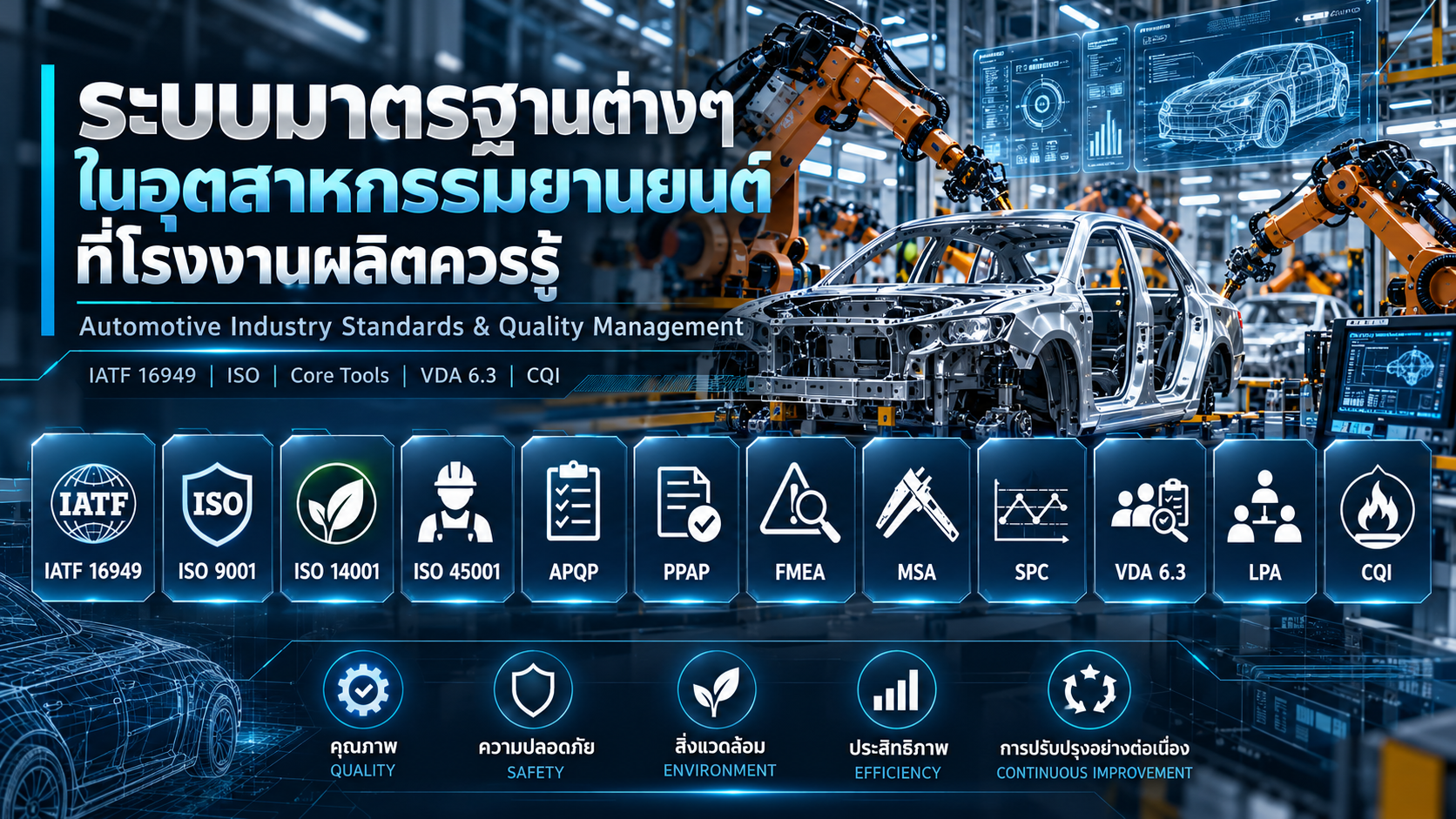
Essential Automotive Industry Standards Every Manufacturer Should Know
A Practical Guide to IATF 16949, ISO Management Systems, Automotive Core Tools, VDA 6.3, CQI Special Process Assessments and Customer-Specific Requirements
The automotive industry operates under strict expectations for product quality, manufacturing consistency, safety and supply chain reliability.
Automotive components must meet specified engineering requirements while maintaining consistent performance throughout mass production.
Quality control extends beyond final product inspection. It includes material selection, product development, process planning, equipment capability, supplier management, testing, traceability and continuous improvement.
To manage these requirements, automotive manufacturers and suppliers use various management system standards, quality methodologies and process assessment guidelines.
Among the most widely recognized are IATF 16949, ISO 9001, ISO 14001, ISO 45001, APQP, PPAP, FMEA, MSA, SPC, VDA 6.3 and AIAG CQI Special Process Assessments.
However, these documents do not all serve the same purpose.
Some define management system requirements, others provide quality planning methods, while others establish process assessment guidelines or customer-specific expectations.
This article explains the essential automotive industry standards and how they support reliable manufacturing operations.
1. Why Are Automotive Manufacturing Standards Important?
Automotive components are produced in complex supply chains involving vehicle manufacturers, component manufacturers, material suppliers and specialized production service providers.
Many products must operate reliably for extended periods under demanding mechanical, thermal and environmental conditions.
Manufacturers therefore need systematic methods to control product quality and manufacturing processes.
Important objectives include:
Preventing manufacturing defects
Reducing process variation
Maintaining dimensional accuracy
Improving product reliability
Supporting material and product traceability
Managing supplier performance
Controlling engineering changes
Meeting customer requirements
Reducing scrap and rework
Supporting continuous improvement
An effective quality management system connects these activities throughout the product life cycle.
2. Main Categories of Automotive Standards
Automotive manufacturing requirements can be grouped into five major categories.
Management System Standards
IATF 16949 – Automotive Quality Management Systems
ISO 9001 – Quality Management Systems
ISO 14001 – Environmental Management Systems
ISO 45001 – Occupational Health and Safety Management Systems
Automotive Quality Core Tools
APQP – Advanced Product Quality Planning
PPAP – Production Part Approval Process
FMEA – Failure Mode and Effects Analysis
MSA – Measurement System Analysis
SPC – Statistical Process Control
Control Plan – Manufacturing Process Control Planning
Process and Supplier Assessments
VDA 6.3 – Process Audit
LPA – Layered Process Audit
Supplier Quality Audits
Special Process Assessments
CQI-9 – Heat Treating
CQI-11 – Plating
CQI-12 – Coating
CQI-15 – Welding
CQI-17 – Soldering
Customer-Specific Requirements
Additional requirements established by automotive OEMs and their suppliers.
The applicable requirements depend on the organization's activities, products, customers and contractual obligations.
3. IATF 16949 – Automotive Quality Management Systems
IATF 16949 is an automotive quality management system standard developed by the International Automotive Task Force.
IATF 16949:2016 focuses on defect prevention, process control, variation reduction and continuous improvement throughout the automotive supply chain.
The standard is applied in conjunction with ISO 9001 requirements and applicable customer-specific requirements.
Key Principles
Defect Prevention
Identify and control risks before manufacturing defects occur.
Risk-Based Thinking
Evaluate threats to product quality, manufacturing continuity and customer satisfaction.
Traceability
Maintain appropriate records to identify materials, processes and affected products.
Change Management
Control changes to products, equipment, processes and suppliers.
Supplier Quality Management
Monitor and develop supplier quality performance.
Problem Solving
Identify root causes and implement effective corrective actions.
Practical Example
Consider a CNC machining process producing automotive shafts.
Tool wear may cause the finished diameter to gradually drift toward its specification limit.
Instead of relying only on final inspection, an effective quality system uses suitable in-process measurements, process monitoring and predefined reaction plans.
Certification Considerations
IATF certification eligibility is subject to specific rules and manufacturing scope requirements.
A company manufacturing automation equipment or fixtures for automotive factories does not automatically qualify for IATF 16949 certification solely because its customers operate in the automotive industry.
4. ISO 9001 – Quality Management Systems
ISO 9001 provides internationally recognized requirements for quality management systems across many industries.
ISO 9001:2026 was published in September 2026, replacing ISO 9001:2015.
Organizations with certification to the previous edition should consult their certification bodies regarding the applicable transition arrangements.
Main Requirements and Practices
Process management
Documented information control
Customer requirements management
Risk and opportunity management
Product and service conformity
Internal auditing
Corrective action
Performance evaluation
Continual improvement
Practical Example
A precision machining company may use ISO 9001 principles to manage engineering drawing revisions, incoming material inspection, dimensional inspection, nonconforming products and customer complaints.
ISO 9001 vs. IATF 16949
ISO 9001 is a general quality management system standard.
IATF 16949 establishes additional automotive-sector requirements within its defined certification framework.
ISO 9001 certification does not automatically mean the organization is certified to IATF 16949.
5. ISO 14001 – Environmental Management Systems
ISO 14001 provides requirements for establishing and continually improving an environmental management system.
ISO 14001:2026 is the current edition, replacing ISO 14001:2015.
The standard helps organizations identify environmental aspects, manage compliance obligations and improve environmental performance.
Industrial Applications
Waste management
Chemical handling
Cutting fluid management
Air emissions control
Wastewater management
Energy efficiency
Resource conservation
Environmental compliance
For example, a CNC machining factory may establish procedures for storing, using and disposing of metalworking fluids and other process wastes.
6. ISO 45001 – Occupational Health and Safety
ISO 45001 provides requirements for managing occupational health and safety risks.
As of October 2026, ISO 45001:2018 remains the published edition, with a newer revision under development.
Main Applications
Hazard identification
Occupational risk assessment
Machinery safety management
Electrical safety
Hazardous energy control
Chemical safety
Workplace inspections
Incident investigation
Worker participation
For example, a factory operating mechanical presses should identify hazards and implement appropriate protective measures based on its risk assessment.
ISO 45001 defines management system requirements. It does not replace machinery-specific safety engineering standards.
7. Automotive Quality Core Tools
Automotive Quality Core Tools support product development, manufacturing process planning, quality verification and ongoing process improvement.
The main tools are APQP, PPAP, FMEA, MSA, SPC and Control Plan.
APQP – Advanced Product Quality Planning
APQP is a structured approach to preparing a product and manufacturing process for production.
Common activities include:
Understanding customer requirements
Project planning
Product design verification
Manufacturing process planning
Risk assessment
Equipment and tooling preparation
Process validation
Production readiness
AIAG published APQP 3rd Edition in 2024.
PPAP – Production Part Approval Process
PPAP provides a method for demonstrating that a production process can consistently manufacture parts meeting engineering and customer requirements.
Typical supporting evidence may include:
Engineering design records
Dimensional inspection results
Material testing results
Process Flow Diagram
Process FMEA
Control Plan
Measurement System Analysis
Process capability studies
Sample production parts
Part Submission Warrant (PSW)
The required submission level and supporting documents depend on customer requirements.
PPAP is a part approval process, not a management system certification.
FMEA – Failure Mode and Effects Analysis
FMEA identifies potential failures, their effects, causes and associated risk controls.
DFMEA addresses product design risks.
PFMEA addresses manufacturing process risks.
For example, an assembly fixture may allow a component to be inserted in the wrong orientation.
A PFMEA can identify this potential failure and support the development of a poka-yoke mechanism.
The AIAG & VDA FMEA methodology uses a structured seven-step approach and Action Priority to guide risk reduction activities.
Control Plan
A Control Plan documents how important product and process characteristics are monitored and controlled.
Typical information includes:
Manufacturing operation
Product or process characteristic
Specification and tolerance
Measurement method
Inspection frequency
Control method
Reaction plan
AIAG published a standalone Control Plan 1st Edition manual in 2024.
MSA – Measurement System Analysis
MSA evaluates the quality and suitability of measurement systems.
Typical considerations include:
Bias
Linearity
Stability
Repeatability
Reproducibility
Gage R&R
For example, if a shaft tolerance is narrow, measurement variation must be sufficiently understood to avoid incorrect acceptance decisions.
Calibration alone does not fully replace measurement system analysis.
SPC – Statistical Process Control
SPC uses statistical methods to monitor manufacturing process variation and stability.
Common tools include:
X-bar and R Charts
Individuals and Moving Range Charts
Process Capability Analysis
Cp and Cpk
Pp and Ppk
In July 2026, AIAG and VDA published a harmonized SPC manual to support consistent statistical process control practices across the automotive supply chain.
8. How Automotive Core Tools Work Together
Consider a factory producing a precision metal bracket.
Step 1: APQP
Plan manufacturing requirements, equipment, resources and quality activities.
Step 2: Process Flow Diagram
Define the manufacturing sequence:
Cutting → CNC Machining → Deburring → Inspection → Packaging
Step 3: PFMEA
Identify manufacturing risks such as incorrect positioning, tool wear and dimensional errors.
Step 4: Control Plan
Establish inspection methods, frequency and reaction plans for important characteristics.
Step 5: MSA
Evaluate the capability of the measurement methods.
Step 6: SPC
Monitor the stability and variation of the manufacturing process.
Step 7: PPAP
Compile the required evidence to demonstrate process and product readiness.
These tools should remain connected as the manufacturing process changes.
For example, a new process risk identified through PFMEA may require additional controls in the Control Plan.
9. VDA 6.3 – Process Audit
VDA 6.3 is a process audit methodology developed by the German automotive industry association.
The 2023 edition addresses automotive product and process development, implementation and series production.
Main Elements
P1 – Potential Analysis
P2 – Project Management
P3 – Planning Product and Process Development
P4 – Implementation of Product and Process Development
P5 – Supplier Management
P6 – Process Analysis / Production
P7 – Customer Care, Customer Satisfaction and Service
Practical Application
An automotive customer may use VDA 6.3 to evaluate a supplier's manufacturing readiness, production controls, quality performance and process risk management.
VDA 6.3 is a process assessment methodology. It does not replace IATF 16949 certification.
10. LPA – Layered Process Audit
Layered Process Audit is a structured approach to verifying that important process controls are implemented consistently.
Audits may involve employees and management personnel at different organizational levels.
AIAG provides CQI-8 as a guideline for Layered Process Audits.
Example LPA Checks
Are current work instructions available?
Have the required pre-operation checks been completed?
Are poka-yoke devices functioning?
Are inspection tools suitable for use?
Are required inspections performed?
Are nonconforming products correctly identified?
Are abnormal conditions reported and addressed?
LPA should focus on actual process behavior and control effectiveness rather than checklist completion alone.
11. CQI Special Process Assessments
AIAG CQI Special Process Assessments provide structured methods for evaluating selected manufacturing processes.
These are particularly important where final inspection alone may not provide complete confidence in the process outcome.
CQI-9 – Heat Treating
Addresses heat treatment system assessments and related process controls.
CQI-11 – Plating
Addresses plating process management and control.
CQI-12 – Coating
Addresses coating process management and control.
CQI-15 – Welding
Provides assessment guidance for applicable welding processes used in automotive production.
CQI-17 – Soldering
Addresses soldering systems used in automotive electronic assembly manufacturing.
Are All CQI Assessments Mandatory?
No.
Applicability depends on the actual manufacturing process, applicable customer requirements and contractual scope.
A machining factory without in-house heat treating or welding does not automatically need to perform every CQI special process assessment.
Outsourced processes may still require supplier oversight.
12. Customer-Specific Requirements (CSR)
Customer-Specific Requirements are additional requirements established by automotive OEMs or other customers.
They may cover:
PPAP submission
Product safety
Traceability
Engineering change approval
Supplier development
Process capability
Quality reporting
Nonconforming product management
Corrective action
Customer notification
Automotive manufacturers such as Ford, General Motors, BMW, Mercedes-Benz, Volkswagen and Stellantis publish customer-specific requirements within applicable programs and scopes.
Requirements may be updated, so suppliers should verify the latest controlled versions.
IATF certification does not automatically establish compliance with every customer-specific requirement.
13. Requirements Across OEM, Tier 1, Tier 2 and Tier 3 Suppliers
Automotive supply chains commonly include:
OEM: The vehicle manufacturer.
Tier 1: A supplier delivering directly to the OEM.
Tier 2: A supplier providing parts or materials to Tier 1 manufacturers.
Tier 3: A supplier serving other upstream suppliers.
Requirements vary depending on product type, contractual relationships and customer expectations.
Lower-tier suppliers may still be required to apply Automotive Core Tools, traceability systems and quality controls when these requirements are passed down through customer agreements.
14. Applying Automotive Quality Principles to Automation Machinery
Consider an automated inspection and reject system containing:
Conveyor
PLC Controller
Vision Camera
Inspection Sensors
Pneumatic Actuators
Reject Mechanism
HMI
Safety System
Quality Control
Inspection requirements must be clearly specified.
Measurement capability should be evaluated using suitable methods, including MSA where applicable.
Process Risk
PFMEA can identify potential problems, including:
Sensor detection failure
Incorrect inspection result
Reject actuator malfunction
Nonconforming parts passing through the process
Missing traceability records
Control Plan
Define the inspection activities, process monitoring and reaction plans.
Machinery Safety
Assess hazards and provide suitable safety measures such as guarding, interlocks and validated safety functions.
Machine Acceptance
Depending on the project, acceptance testing may cover:
Functional testing
Inspection performance
Reject accuracy
Cycle time
Alarm response
Safety function validation
Factory Acceptance Test (FAT)
Site Acceptance Test (SAT)
These activities illustrate how quality management, engineering design and machine safety contribute to a reliable production system.
15. How Should a Factory Begin Implementing Automotive Standards?
Step 1: Identify Customer Requirements
Determine which standards, tools and specific requirements are applicable.
Step 2: Assess the Existing Quality System
Review documentation, workforce competence, manufacturing equipment and inspection processes.
Step 3: Establish Process Controls
Develop suitable process flows, work instructions, inspection methods and nonconforming product controls.
Step 4: Train Personnel
Build knowledge of Automotive Core Tools across engineering, production, quality and purchasing teams.
Step 5: Integrate Quality Documents
Ensure PFMEA, Process Flow, Control Plan and inspection records remain consistent.
Step 6: Verify Process Capability
Use suitable measurement analysis, process monitoring and validation activities.
Step 7: Conduct Audits
Evaluate process implementation and corrective action effectiveness.
Step 8: Prepare Customer Evidence
Maintain the documentation and records required by applicable customer specifications.
The purpose should be to establish a functioning quality system rather than creating documentation solely for audits.
16. Important Manufacturing Quality KPIs
Common automotive manufacturing performance indicators include:
| KPI | Purpose |
|---|---|
| PPM | Monitor defective parts per million |
| Scrap Rate | Measure manufacturing waste |
| Rework Rate | Monitor products requiring correction |
| OEE | Evaluate overall equipment effectiveness |
| OTD | Measure on-time delivery performance |
| Cp / Cpk | Evaluate process capability under appropriate conditions |
| Customer Complaints | Monitor customer-reported problems |
| Corrective Action Closure | Track corrective action completion and effectiveness |
Specific targets should be determined according to customer requirements, process characteristics and organizational objectives.
17. Common Mistakes in Automotive Quality Systems
Treating ISO 9001 as Equivalent to IATF 16949
The standards are related but have different requirements and certification scopes.
Preparing FMEA Only for Documentation
FMEA should lead to effective risk controls and process improvements.
Failing to Update the Control Plan
Changes to manufacturing processes may require updates to related quality documents.
Confusing Calibration with MSA
Calibration does not evaluate every source of measurement system variation.
Using SPC Without Reaction Plans
Control charts are less effective when abnormal conditions are not addressed.
Treating VDA 6.3 as a Replacement for IATF
VDA 6.3 is a process audit methodology, not an equivalent management system certification.
Ignoring Customer-Specific Requirements
Suppliers may fail customer expectations even when they comply with general quality system requirements.
Applying Every CQI Assessment Regardless of Scope
Special process assessments should be selected according to applicable activities and requirements.
18. Frequently Asked Questions
Does Every Automotive Parts Manufacturer Need IATF 16949?
Not automatically. The requirement depends on certification eligibility, product scope, customer expectations and contractual obligations.
What Is the Difference Between APQP and PPAP?
APQP focuses on planning and developing product and process quality. PPAP provides structured evidence for production part approval.
How Are FMEA and Control Plans Connected?
FMEA identifies risks and potential failures, while the Control Plan establishes appropriate monitoring and control activities.
Why Is MSA Important in CNC Manufacturing?
MSA helps determine whether measurement results are sufficiently reliable for quality decisions.
Is VDA 6.3 an ISO Certification?
No. It is a process audit methodology.
Is Every CQI Special Process Assessment Required?
No. Applicability depends on the manufacturing processes and customer requirements.
Does an Automation Machine Manufacturer Automatically Need IATF 16949?
No. Manufacturing equipment for automotive customers does not automatically establish eligibility for IATF 16949 certification.
19. Conclusion
Automotive manufacturing standards and quality tools provide a structured approach to reliable product development and production.
IATF 16949 and ISO 9001 establish quality management frameworks.
ISO 14001 and ISO 45001 support environmental and occupational safety management.
APQP, PPAP, FMEA, MSA, SPC and Control Plans provide practical methods for planning and controlling product and process quality.
VDA 6.3 and LPA support process assessment and verification.
CQI Special Process Assessments address selected critical manufacturing processes, while Customer-Specific Requirements establish additional obligations based on customer expectations.
Although these systems serve different purposes, their effective integration helps manufacturers prevent defects, control process variation, reduce waste and improve customer confidence.
An effective manufacturing standard is not simply a document used to pass an audit. It is a practical system that helps an organization control, verify and continually improve the quality of its production processes.
AC DESIGN AND DEVELOPMENT – Industrial Automation & Engineering Solutions
AC DESIGN AND DEVELOPMENT CO., LTD. provides customized industrial engineering and manufacturing solutions.
Our services include:
Automation Machine Design and Manufacturing
Custom Jig & Fixture
Conveyor Systems
Machine Parts Manufacturing
Industrial Steel Structures
Custom Engineering Solutions
Our engineering approach focuses on practical manufacturing requirements, reliable mechanical systems, dimensional accuracy and efficient production processes.
Industrial Engineering and Automation Solutions Across Thailand
Website: https://acdesignanddevelopment.com/
Tel: +66 82-210-0792
Technical Disclaimer: This article is provided for educational purposes. Standard editions and requirements are described as of October 2026. Actual compliance and certification obligations must be verified against official standards, applicable certification rules, customer-specific requirements and relevant legal requirements.