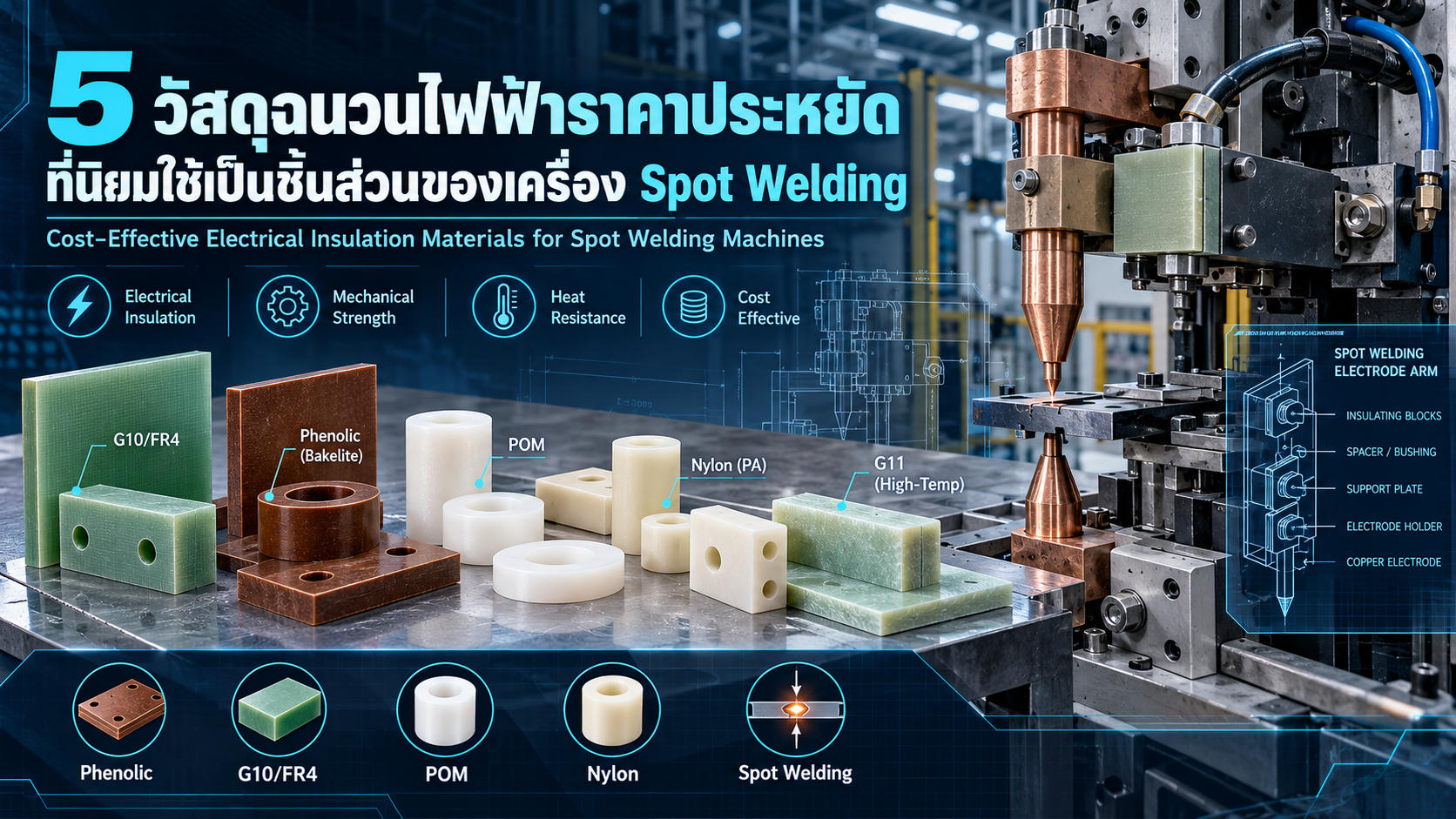
5 Cost-Effective Electrical Insulation Materials for Spot Welding Machines
A Practical Guide to Selecting Insulating Plates, Bushings, Spacers and Fixture Components for Resistance Spot Welding Equipment
Electrical insulation materials play an important role in the design and manufacturing of resistance spot welding equipment.
While copper and copper alloys provide the electrical conductivity required for welding electrodes and current-carrying components, insulating materials help separate selected metallic structures, prevent unintended electrical current paths and support mechanical components.
Selecting an appropriate insulation material requires balancing electrical properties, operating temperature, mechanical strength, dimensional stability, machinability and overall cost.
This article introduces five cost-effective insulating materials for consideration in spot welding machine components: Paper Phenolic, Cotton Phenolic, G10/FR4, POM and Nylon.
1. Why Do Spot Welding Machines Need Electrical Insulation?
Resistance Spot Welding joins metal sheets by applying electrode force and passing a high electrical current through the weld area.
The welding heat follows the fundamental relationship:
Q = I²Rt
Where:
Q = Heat energy
I = Welding current
R = Electrical resistance
t = Welding time
Insulation materials are used where electrical separation is required between structural elements or mechanical components.
Typical applications may include:
Insulating plates
Insulating spacers
Insulating bushings
Insulating washers
Fixture insulation components
Support blocks
Insulating materials must not interrupt the intended welding current path between the electrodes and the workpiece.
Material placement should be determined through proper electrical and mechanical design.
2. Paper Phenolic – An Economical Insulation Material
Paper Phenolic is manufactured from layers of resin-impregnated paper bonded under heat and pressure.
It is sometimes referred to as Bakelite in industrial applications, although the specific material grade should always be identified.
Advantages
Relatively low material cost
Useful electrical insulation properties
Good machinability
Available in sheet form
Suitable for light-duty components
Limitations
Lower impact resistance than some engineering thermoplastics
Electrical properties can be affected by moisture
Limited thermal performance
May crack under unsuitable mechanical loading
Typical Applications
Paper Phenolic may be considered for insulating plates, washers, electrical barriers and low-load support components located away from high-temperature welding zones.
3. Cotton Phenolic – Mechanical Strength and Electrical Insulation
Cotton Phenolic is a composite laminate made from cotton fabric reinforced with phenolic resin.
Its combination of mechanical strength and machinability makes it suitable for various industrial components.
Common grades include C, CE, L and LE.
Grades CE and LE are designed with electrical insulation applications in mind.
Advantages
Good mechanical strength
Suitable for machined bushings and spacers
Useful wear resistance
Available in multiple grades
Balanced mechanical and electrical performance
Limitations
Properties vary between grades
Moisture absorption must be considered
Laminate orientation affects mechanical performance
Operating temperature is limited by the selected grade
Typical Applications
Cotton Phenolic can be evaluated for insulating bushings, spacers, support plates and selected fixture components.
4. G10/FR4 – Strong Glass-Epoxy Electrical Insulation
G10 and FR4 are glass-fiber-reinforced epoxy laminates with good mechanical and dielectric properties.
FR4 is a flame-retardant grade, while G10 does not automatically provide the same flame rating.
These materials are useful where mechanical rigidity and electrical insulation are both important.
Advantages
High mechanical strength
Good dielectric performance
Low moisture absorption
Suitable for structural insulating components
Can be machined into custom shapes
Limitations
Generally more expensive than basic paper phenolic
Abrasive to cutting tools
Requires appropriate dust control during machining
Temperature limits must be verified
Mechanical properties depend on laminate orientation
Typical Applications
G10/FR4 may be considered for insulating plates, structural spacers, support blocks and selected electrode assembly components outside the intended current path.
5. POM – Precision-Machined Insulating Components
POM, also known as Acetal or Polyoxymethylene, is an engineering thermoplastic commonly used for precision-machined components.
Non-conductive POM-C grades offer low moisture absorption and good dimensional stability under suitable conditions.
Advantages
Excellent machinability
Low moisture absorption
Good sliding properties
Suitable for precision bushings
Useful electrical insulation properties
Limitations
Limited continuous operating temperature
Can deform under sustained compression
Not suitable for direct exposure to welding heat
Electrically modified grades may have different insulation properties
Typical Applications
POM may be considered for bushings, guide blocks, spacers and fixture parts in lower-temperature areas of a welding machine.
6. Nylon PA6 / PA66 – Tough and Wear-Resistant Insulation
Nylon is an engineering thermoplastic known for toughness, wear resistance and useful mechanical properties.
PA6, PA66 and cast nylon grades are commonly used in industrial mechanical components.
Advantages
Good toughness
Wear resistance
Suitable for sliding components
Useful electrical insulation
Readily machinable
Limitations
Moisture absorption affects dimensions
Thermal resistance varies by grade
Long-term compression may cause deformation
Not suitable for direct welding heat exposure
Typical Applications
Nylon can be evaluated for insulating guide bushings, sliding blocks and mechanical spacers where operating temperatures remain within material limits.
7. Higher-Temperature Alternative: G11
When the operating temperature exceeds the capabilities of conventional G10/FR4, a higher-temperature glass-epoxy laminate such as G11 may be appropriate.
Some G11 grades are rated for operating temperatures around 180°C while maintaining useful mechanical and electrical properties.
However, G11 is generally a higher-cost material and should be selected where its additional performance is necessary.
Components directly exposed to severe welding heat may require specialized insulation materials or ceramics.
8. Material Comparison
| Material | Typical Long-Term Temperature* | Main Advantage |
|---|---|---|
| Paper Phenolic | Approx. 120°C | Low cost |
| Cotton Phenolic | Approx. 120–125°C | Mechanical strength |
| G10 / FR4 | Approx. 130°C | Structural insulation |
| POM-C | Approx. 100°C | Precision machining |
| Nylon PA6 | Approx. 100°C | Toughness and wear resistance |
| G11 | Up to approx. 180°C | Higher-temperature performance |
Values are representative examples from specific material grades and datasheets. They are not universal ratings or guarantees of suitability for resistance spot welding applications.
9. Selecting the Right Material by Component
Insulating Plates
For structural electrical insulation under compression, G10/FR4 or electrical-grade Cotton Phenolic may be appropriate candidates.
Bushings and Spacers
POM or Nylon may be suitable in lower-temperature applications where machining accuracy, sliding properties or toughness are important.
Components Near Welding Electrodes
Actual part temperatures must be measured or calculated. Where conventional laminate temperature limits are exceeded, higher-temperature alternatives should be evaluated.
Welding Fixtures
Material selection depends on required electrical separation, mechanical loading, operating temperature, wear conditions and dimensional accuracy.
10. Important Engineering Considerations
Before selecting an insulation material, engineers should evaluate:
Actual continuous and peak component temperatures
Applied compression and mechanical loading
Electrical insulation requirements
Moisture and cooling-water exposure
Potential unintended current paths through fasteners
Dimensional stability and material creep
Machining requirements and material orientation
Maintenance and replacement costs
A low material price does not necessarily result in the lowest overall operating cost.
For example, a higher-performance insulating plate may offer better lifecycle value if it reduces deformation, replacement frequency and unplanned downtime.
11. Frequently Asked Questions
Which insulation material is the most economical?
Paper Phenolic is often among the most economical options for suitable light-duty electrical insulation components. Actual prices vary by grade, thickness and supplier.
Is G10 better than POM?
Neither material is universally better. G10 is generally suited to rigid structural insulation, while POM is attractive for precision-machined components in lower-temperature applications.
Can Nylon be used near spot welding electrodes?
Only if actual operating temperature, mechanical loading and insulation requirements fall within the selected material's limits.
Does FR4 withstand direct welding heat?
FR4 should not be assumed suitable for direct exposure to the intense heat at a spot welding location. Its thermal performance must be verified at the actual installation position.
Is a high-temperature material always necessary?
No. Selecting a material based on the actual component temperature and operating conditions can help avoid unnecessary expense.
12. Conclusion
Selecting cost-effective electrical insulation materials is an important part of resistance spot welding machine design.
Paper Phenolic and Cotton Phenolic offer economical options for suitable components, while G10/FR4 provides a useful combination of electrical insulation and structural strength.
POM and Nylon are attractive options for precision-machined bushings, spacers and mechanical guide components in lower-temperature areas.
Higher-temperature materials such as G11 should be considered when operating conditions exceed the limits of conventional insulating materials.
The best insulation material is not necessarily the cheapest material, but the one that delivers reliable performance at an appropriate total cost.
AC DESIGN AND DEVELOPMENT – Engineering & Machine Parts Solutions
AC DESIGN AND DEVELOPMENT CO., LTD. provides custom engineering and manufacturing solutions for industrial applications.
Our services include:
Automation Machine Design and Manufacturing
Custom Machine Parts
Jig & Fixture
Conveyor Systems
Industrial Steel Structures
Custom Engineering Solutions
We focus on practical engineering solutions that support manufacturing quality, reliability and cost efficiency.
Engineering and Manufacturing Services Across Thailand
Website: https://acdesignanddevelopment.com/
Tel: +66 82-210-0792
Technical Disclaimer: The information provided is intended for engineering education. Material selection and machine modifications must be verified against manufacturer specifications, operating conditions and applicable safety requirements.