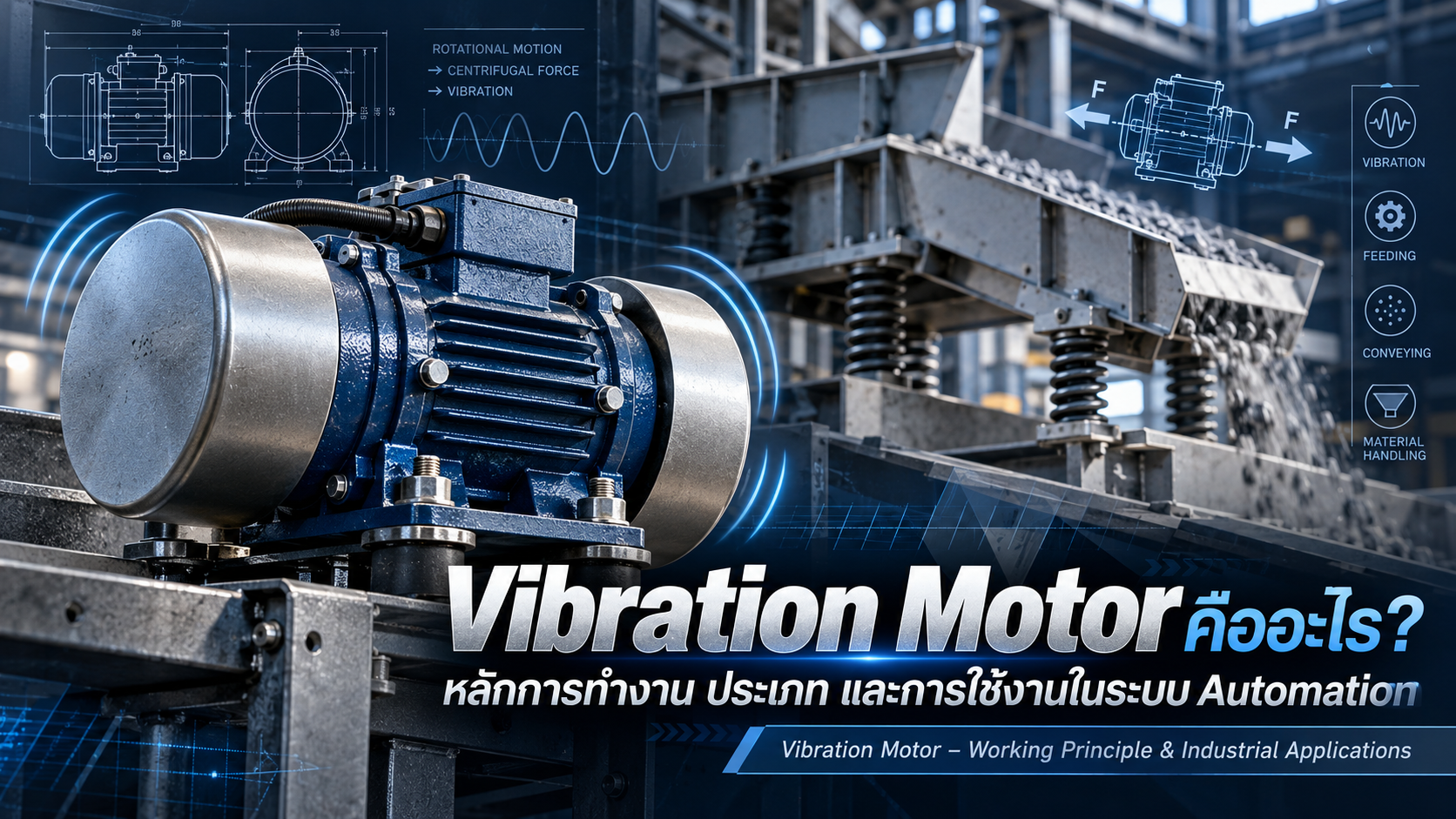
What Is a Vibration Motor? Working Principle, Types and Industrial Applications
Understanding Eccentric Weights, Centrifugal Force, Vibration Frequency, Motor Selection and Industrial Automation Applications
Vibration motors are widely used in industrial manufacturing, bulk material handling, automated feeding systems and material screening equipment.
Their primary purpose is to generate controlled mechanical vibration that helps move, distribute, discharge or compact materials.
Unlike conventional electric motors, which are generally designed to minimize unwanted vibration, industrial vibration motors are specifically engineered to generate oscillating forces.
These forces are commonly produced by rotating eccentric weights mounted on the motor shaft.
Understanding the operating principle, vibration force, frequency and installation requirements is essential for selecting and integrating a vibration motor into industrial machinery.
1. What Is a Vibration Motor?
A Vibration Motor is an electric motor designed to generate mechanical vibration, typically through rotating eccentric or unbalanced masses.
When the motor rotates, the eccentric weights create a continuously changing excitation force.
This force is transmitted through the motor housing and mounting base into the connected machine structure.
Common industrial applications include:
Vibrating Feeders
Vibrating Screens
Hopper Discharge Systems
Vibrating Conveyors
Vibration Tables
Bulk Material Handling Equipment
Automated Material Feeding Systems
The resulting vibration depends on the motor characteristics, mounting arrangement, moving mass, supporting springs and structural dynamics.
2. How Does a Vibration Motor Work?
The operating principle of a typical industrial vibration motor is based on rotating unbalanced masses.
An eccentric weight is mounted so that its center of mass is offset from the rotational axis.
As the motor shaft rotates, this offset mass generates a rotating excitation force.
Main Components
Electric Motor: Produces the rotational motion.
Motor Shaft: Transfers rotation to the eccentric weights.
Eccentric Weights: Generate the unbalanced excitation force.
Bearings: Support the rotating assembly and its operating loads.
Motor Housing: Protects internal components and transmits vibration.
Mounting Base: Connects the motor to the equipment structure.
Operating Sequence
Electrical power is supplied to the motor.
The motor shaft begins rotating.
The eccentric weights rotate with the shaft.
A rotating excitation force is generated.
The force is transferred into the machine structure.
The machine responds according to its mass, stiffness, damping and mounting arrangement.
3. What Is an Eccentric Weight?
An eccentric weight is a rotating mass whose center of gravity is located away from the shaft's rotational axis.
The rotating unbalance produces the excitation force used to vibrate the machine.
Many industrial vibration motors include adjustable eccentric weights on both ends of the shaft.
Adjusting the relative positions of the weights changes the effective rotating unbalance.
This allows the motor's centrifugal force output to be adjusted within the manufacturer's specified range.
Important: Eccentric weight adjustments must follow the manufacturer's instructions. Both shaft ends must be configured as specified to prevent unintended loading.
4. Vibration Motor Force Calculation
The theoretical excitation force generated by a rotating eccentric mass can be estimated using:
F = m × r × ω²
Where:
F = Excitation force magnitude (N)
m = Unbalanced mass (kg)
r = Eccentricity radius (m)
ω = Angular velocity (rad/s)
Angular velocity is calculated as:
ω = 2πn / 60
Where n is rotational speed in RPM.
Calculation Example
Assume:
Unbalanced mass = 0.10 kg
Eccentricity radius = 0.020 m
Rotational speed = 1,500 RPM
Angular velocity is approximately:
ω = 157.08 rad/s
Therefore:
F = 0.10 × 0.020 × 157.08²
F ≈ 49.35 N
This is approximately 5.03 kgf.
If the rotational speed increases to 3,000 RPM, with the same effective unbalance:
F ≈ 197.39 N
The theoretical force becomes four times greater because centrifugal excitation force is proportional to rotational speed squared.
This calculation represents an idealized unbalance force magnitude, not the actual transmitted force or acceleration of a complete vibrating machine.
Actual performance depends on structural mass, stiffness, damping, resonance and the configuration of all eccentric weights.
5. Types of Vibration Motors
AC Vibration Motor
AC vibration motors operate from alternating-current power supplies.
They are commonly used in factories and industrial processing equipment.
Available configurations may include single-phase and three-phase motors.
Applications include vibrating screens, feeders, hoppers and vibration tables.
DC Vibration Motor
DC vibration motors operate using direct-current power, commonly 12VDC or 24VDC in suitable models.
They can be useful in compact machines, mobile equipment and battery-powered applications.
Three-Phase Industrial Vibrator
Three-phase industrial vibrators are designed for demanding applications that require reliable mechanical excitation.
Selection depends on electrical ratings, rotational speed, centrifugal force, operating duty and environmental requirements.
High-Frequency Vibration Motor
High-frequency vibrators are developed for applications requiring increased vibration frequency, including certain concrete compaction and industrial processing systems.
They should not be substituted with standard motors operating beyond their rated speed.
Electromagnetic Vibrator
Electromagnetic vibrators generate vibration through magnetic attraction rather than rotating eccentric weights.
They are commonly used in certain feeding and dosing systems.
Although they perform similar functions, their operating and control principles differ from rotating vibration motors.
6. Single vs. Dual Vibration Motors
Single Motor Configuration
A single rotating unbalance motor generates a continuously rotating force vector.
Depending on the equipment design, this can produce circular or elliptical vibration.
Such arrangements are commonly used for material-flow assistance and certain vibrating machines.
Dual Motor Configuration
Two properly arranged counter-rotating vibration motors can generate linear excitation.
When the motors operate with suitable phase synchronization, force components in one direction cancel while those in the intended direction reinforce each other.
Applications may include:
Linear Vibrating Feeders
Linear Vibrating Screens
Vibrating Conveyors
Certain Vibration Tables
Proper synchronization, mounting, structural stiffness and rotational direction are necessary for reliable operation.
7. Industrial Applications of Vibration Motors
Vibrating Feeder
A vibrating feeder uses controlled vibration to move bulk materials along a feeding trough.
Material movement depends on excitation direction, vibration amplitude, frequency and friction.
Hopper and Silo Discharge
External vibration motors can be used to improve material discharge and reduce material adhesion or bridging.
However, incorrect vibration settings may compact certain materials rather than improve flow.
Vibrating Screen
Vibration enables materials to move across screening surfaces for classification and separation by particle size.
Vibrating Conveyor
A vibrating conveyor moves material along a trough through controlled vibratory motion.
Vibration Table
Vibration tables are used for compaction, material settling and selected testing operations.
Precision vibration testing may require specialized equipment with controlled acceleration and frequency profiles.
Industrial Automation
Vibration motors can support automated feeding, product distribution, screening and bulk-material handling processes.
8. How to Select a Vibration Motor
Selecting the correct vibration motor involves several engineering considerations.
Centrifugal Force
The rated force must be evaluated together with the moving mass and desired vibration behavior.
Rotational Speed
Motor speed affects both excitation frequency and force output.
Vibration Frequency
For a rotating unbalance system:
Vibration Frequency (Hz) = RPM / 60
For example, 1,500 RPM produces an excitation frequency of approximately 25Hz.
Moving Mass
The total vibrating mass includes the equipment structure and material load.
Mounting Structure
The frame and mounting points must withstand repeated dynamic loading.
Suspension and Isolation
Springs or vibration isolators may be required to control machine movement and reduce vibration transmission to nearby equipment.
Duty Cycle
Determine whether the motor must operate continuously or intermittently.
Operating Environment
Consider temperature, moisture, dust, corrosion and hazardous-area requirements.
9. PLC and VFD Control of Vibration Motors
Vibration motors can be integrated into PLC-controlled industrial systems.
Example: Automated Hopper Discharge
A sensor verifies the process conditions.
The PLC evaluates the programmed sequence.
A suitable motor-control device energizes the vibration motor.
The motor vibrates the hopper structure.
Material discharge is monitored.
The PLC stops the motor when the required process condition is met.
Variable Frequency Drive (VFD)
A VFD can regulate the speed of compatible AC vibration motors.
Changing the rotational speed affects the excitation frequency and generated force.
However, operating limits must be verified.
Important considerations include motor cooling, resonance, acceleration and deceleration characteristics, synchronization and maximum permitted speed.
Not every vibration motor is approved for VFD operation.
10. Installation and Safety Considerations
Correct installation is essential for equipment performance and reliability.
Key precautions include:
Follow the manufacturer's mounting instructions.
Use properly sized mounting bolts and specified tightening torque.
Verify the strength of mounting plates and supporting structures.
Prevent access to rotating eccentric weights.
Consider machine resonance and structural fatigue.
Protect electrical connections against vibration damage.
Use suitable motor protection and protective earthing.
Inspect bearings, fasteners and operating temperature.
Follow proper lockout/tagout procedures before maintenance.
Installation recommendations are application-specific. A mounting arrangement suitable for a steel hopper may not be appropriate for a vibrating feeder or screening machine.
11. Common Vibration Motor Problems
Insufficient Vibration
Possible causes include incorrect eccentric weight settings, unsuitable speed, excessive moving mass or incorrect installation.
Excessive Vibration
May result from oversized excitation force, structural resonance or unsuitable support stiffness.
Abnormal Motor Noise
May indicate bearing wear, loose mounting bolts or mechanical damage.
Excessive Heating
Potential causes include electrical problems, bearing damage, inadequate cooling or operating outside the rated conditions.
Loose Mounting Bolts
May be caused by insufficient tightening torque, unsuitable mounting surfaces or excessive dynamic loads.
Poor Material Flow
May be related to the bulk material properties, hopper geometry, moisture, vibration direction or selected excitation parameters.
12. Frequently Asked Questions
What Is the Difference Between a Vibration Motor and a Standard Motor?
A vibration motor is specifically designed to generate mechanical excitation, while a conventional motor is generally designed to deliver rotational power with minimal unwanted vibration.
Can a Vibration Motor Operate at 24VDC?
Yes. Industrial DC vibration motors designed for 24VDC operation are available.
Can Vibration Force Be Adjusted?
Many industrial vibration motors allow adjustment through eccentric weight settings. Compatible models may also support speed control.
Why Are Two Vibration Motors Used Together?
Properly arranged counter-rotating motors can produce directional linear vibration for feeding and screening applications.
Can a VFD Control a Vibration Motor?
Yes, if the manufacturer approves VFD operation and the required operating limits are respected.
How Do I Choose the Correct Motor for a Hopper?
The selection should consider hopper geometry, material characteristics, material load, mounting location, structural properties and manufacturer recommendations.
13. Conclusion
Vibration motors are essential components in many industrial material-handling and automation applications.
By generating controlled mechanical excitation, they support material feeding, discharge, screening, conveying and compaction.
Proper selection requires evaluating centrifugal force, speed, moving mass, vibration frequency, structural response and installation requirements.
Effective vibration is not about producing the maximum possible force. It is about generating the correct vibration for the specific application.
AC DESIGN AND DEVELOPMENT – Industrial Automation Solutions
AC DESIGN AND DEVELOPMENT CO., LTD. provides customized engineering and industrial manufacturing solutions, including:
Automation Machine Design and Manufacturing
Custom Jig & Fixture
Conveyor Systems
Machine Parts Manufacturing
Industrial Steel Structures
Custom Engineering Solutions
We focus on practical engineering solutions that support manufacturing efficiency, process reliability and production quality.
Engineering and Automation Services Across Thailand
Website: https://acdesignanddevelopment.com/
Tel: +66 82-210-0792
Technical Disclaimer: This article is intended for engineering education. Actual motor selection, installation and operation must be verified against manufacturer specifications, structural design requirements and applicable safety procedures.